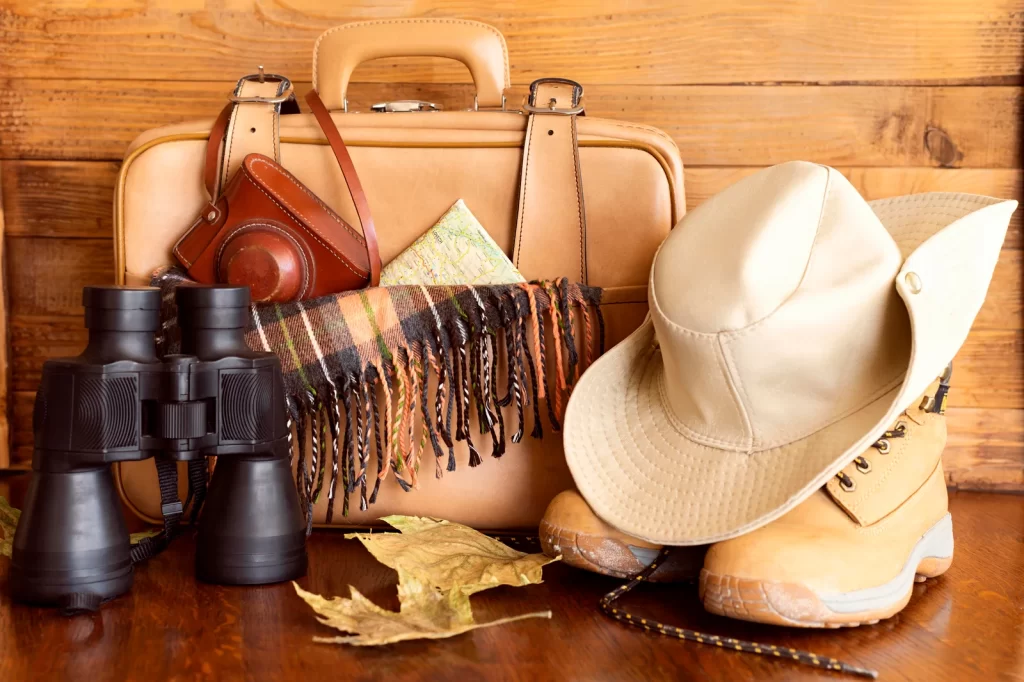
Choosing the right clothing for a Tanzania safari is crucial for comfort, safety, and a successful wildlife experience. Safari attire must balance protection from the elements, concealment from wildlife, and practical comfort for game drives, walking safaris, and other outdoor activities.
1. Clothing Colors and Styles
Neutral colors like khaki, beige, olive, brown, and grey are ideal. These colors blend with the natural environment, making it easier to observe wildlife without startling them. Avoid bright colors, black, or white, which can attract insects or alert animals.
Lightweight, breathable layers are recommended. Mornings and evenings can be chilly, even in the dry season, while midday temperatures can be hot. Layering allows you to adjust your clothing throughout the day.
2. Tops and Shirts
3. Bottoms
4. Jackets and Outerwear
5. Footwear
6. Headwear
7. Accessories
8. Safari-Specific Gear
9. Evening and Camp Clothing
10. Packing Tips
Get inspired by our experts’ African safari blogs, latest news, and travel tips. Discover amazing articles to help you plan your dream safari in East Africa. From insider guides to expert advice, our blog gives you everything you need to organize your perfect luxury safari with confidence.
Verified Thoughtful Guide for Stunning Experience I could not have imagined a more exciting experience. There are many tour guides, but this one managed to customize every moment of the experience for all 6 of us on this tour.Posted onVerified INCREDIBLE ADVENTURE At 49 years old all I have wanted in life was to see a male lion in the wild. Our guide, Johnson, delivered so many male lions I lost count! My safari was one day in the Ngorogoro Crater and 3 days in the Serengeti... Johnson was so knowledgeable about all the animals, the environment, and the culture! He had an amazing eye for spotting everything from the large elephants to the small dung beetle! Such an incredible experience, definitely the trip of a lifetime ❤️❤️Posted onVerified Unbelievable trip of a lifetime 🥰 I don’t even know where to start….4 days in the Serengeti with Johnson and William, is honestly the best 4 days of my life…With amazing friends, on the trip of a life time, Johnson and William made the trip more special than we could ever have imagined. To say we would be lucky enough to see the big 5, and more, was an understatement! The whole trip was made all about the experience for us as customers, which turned in to amazing friendships!! William’s cooking was just fantastic!! And Johnson…you are more than just a tour guide!! Your a friend for life!! We were taken to a very special sunset spot in the depths of the Serengeti where I was proposed too…which would never have been so special without your commitment to make it everything that it was! So we thank you for that! I honestly can’t recommend this company enough, for their want and need to make every trip as special as the next 🥰Love and more, from Kay & Chris xxPosted onVerified Best Experience Ever! I went on the 4 day safari with Johnson and William as out cook. They both took such amazing care of us and William’s cooking was amazing. Johnson was so knowledgeable and was constantly giving us so much great information about the Serengeti and all the animals. He took special care to accommodate all of our requests including making the perfect engagement come to life for our friends. I can’t recommend Meerkat Expeditions enough! I can’t wait to come back and book another Safari with them!Posted onVerified The best decision on my life At the beginning of the safari I was a bit worried about what I was going to see, or what to expect and I can't believe what I found. We did the 4 days and 3 nights safari and I am really grateful to the company. The guide was a perfect company, for this type of excursion you need more than luxuries or a good car with a good driver, you need a person who loves what he does, who teaches you and involves you in the history of each animal of each place, a person who knows what he is doing. The spectacular food from breakfast to lunch, the accommodation was wonderful, and every second every question was answered in the best way, customer service, cleanliness, honesty and satisfaction are the keywords to describe 100% this safari .Posted onVerified Une expérience magique ! Nous avons vécu une expérience unique et incroyable grâce à Johnson, avec qui nous avons échangé pendant plusieurs mois pour organiser notre Safari. Nous avons vu tout les animaux que nous espérions voir ! C’était vraiment incroyable ! N’hésitez pas à organiser votre voyage avec Johnson, c’est une personne adorable et de confiance ! Il fera tout pour que vous passiez le meilleur Safari possible.Je vous souhaite de tout cœur de le vivre ! :)Posted onVerified 4 day safari with Johnson and Justin We just did a 4 day safari to the Serengeti/ngorongoro. We had an INCREDIBLE time- Johnson was our driver and Justin our cook. Each day was an adventure - Johnson always made an extra effort to show us the animals and allow us the best view and photos. The campsites each night were great and we were informed about so much. We never missed a sunrise or opportunity to see an animal and felt safe and informed the whole time. Johnson has so much knowledge - so be sure to bring a notebook if remembering these details is your friend! (I had to ask the same questions 100 times to remember all the information - there was so much to learn and Johnson had knowledge about almost everything).Justin was our cook and the food was always fresh and on time. There was always lots to eat and he was friendly and prompt to clean up too (but of course we helped as well!). It was really affordable too through THE (Tanzanian Host Experience). I would definitley recommend this team- 4 days in a land cruiser could be so long but with this team we had so much fun, so many laughs, learnt so much and had the best once in a lifetime experience! - Lauren (2019 Volunteer)Posted onVerified Great experience on safari We went on a 3 day safari with Johnson, he was a good man with great knowledge. We were able to see a wide variety of animals( including the big 5). The food provided was tamu. It was an amazing and surreal experience, which was tailored to all of us. Thanks again for an experience to remember!!Posted onVerified a simply perfect safari experience! Freddy provided an amazing experience across Nogorogoro, the Serengeti and more! Lodging was top quality, food and service was second to none. While dusty, Freddy and Meerkat couldn't do anything about that! Our driver, Freddy, made every effort to find us the best views, the best history and background and an unparalleled Safari. He was on the radio chasing down Leopards, Cheetahs and Lions. The accommodations found were amazing (we got to see the African sunrise across the Serengeti from our beds inside a tent). We highly recommend Meerkat for your Safari experience! Johnson and Freddy are amazing hosts and every action they took during our trip was to make our experience the best it could be.Posted onVerified An "Exceptional" Experience for Even a "Jaded" Photographer - 10 Days Northern Circuit Tanzania with Meerkat I had two photo safaris in mind, nearly back to back, Masai Mara in Kenya, and the Northern Circuit in Tanzania. Kenya was nailed down, but I was grasping at straws to get the right connections for Tanzania. I found Johnson's review here on Trip Advisor as a guide, and was bowled over by the large number of reviews, all 5 star. A quick email to him indicating my needs, timing, and that I was a "fussy" photographer, came back with a well planned and thoughtful response. No problem in fine tuning the plan (I had a budget so I wanted to reduce some of the accommodation costs - which I regret now as I got very spoiled by the remaining top end places, but that was my fault). Johnson even sacrificed adding another customer whom "I" had suggested - but due to the gap in timing of booking would have had to stay in a different camp, meaning poor logistics each day. This would have been more profitable for Meerkat, but they were more focused on making sure my trip was top notch and indeed it was! Johnson had promised me his "best' guide, someone who was used to working with photographers, and I was NOT disappointed by Edwin, he was superb - the best guide I have ever had the good fortune to work with, and I have done safaris in many places around the world. Eagle Eye Edwin would spot game by his naked eye that I needed a 600mm lens with an addition 7x magnification to see. He was completely situationally aware about what I needed in terms of positioning to get the best angle and view for shots, and quickly figured out the reach of my various lenses and bodies and then positioned us accordingly. In addition to taking very good care of me in general, Edwin was also great company, and we had a lot of laughs as well. I also understand that Meerkat is adding to its inventory of extended jeeps with another even more suited for photography as this is a market they wish to cater to (so I am looking forward even more to my "next" tour with them). Even a non-photographer would have an excellent experience with Meerkat, but my photo safari with them was way over the top. Highly recommended. In order to assess the results of my safari (i.e. what you would be likely to experience in a similar trip of your own), you would have to google my photos on FB, Google Plus or my FREELY available non-commercial website in order to find them, or perhaps check Meerkat's website as I imagine they will post a link to them once I let them know the Tanzania gallery is up.Brant Bady - "The Wandering Honeybadger"
Our travel experts are ready to start creating your tailor made trip.
Arusha Town, Tanzania